
Common Questions About Valentino Bags
Strip away the noise and almost every query about Valentino bags turns on a small cluster of facts that for whatever reason rarely get written down in plain language. Plenty of what is passed around online is mistaken, especially around authentication codes and resale values. A standing source of confusion involves a second company that carries part of the same name. In the answers that follow, only verifiable material is stated as fact, and market practice is flagged where it appears. Prices are observed 2026 market prices as listed on the brand’s own US site, not an official price list. Read the first four answers even if you only wanted pricing, because they prevent the expensive mistakes.
Who created Valentino, and does he design for it today?
The label was founded in Rome in 1960, on Via Condotti, by Valentino Garavani with Giancarlo Giammetti. He sold the company in 1998, stepped away from design in 2007 with a final couture show in January 2008, and died on 19 January 2026 aged 93. No, then: he designed nothing current and he held no stake in the modern house. The house carries on, with Alessandro Michele as creative director since 2024, in succession to Pierpaolo Piccioli. Mayhoola for Investments took valentino leather shoulder bag 70 percent in 2012 and Kering took 30 percent in July 2023, with Kering having announced an intention to acquire the company fully by 2028. Creative operations are still based in Rome, while the legal registration is in Milan.
Do Valentino and Mario Valentino belong to the same company?
No, and it is the most consequential thing to understand before buying. Nothing links Valentino S.p.A., the couture house behind Valentino Garavani accessories, and Mario Valentino S.p.A.: they are separate companies with no relationship. Mario Valentino was established in Naples in 1952, is still headquartered there, and produces leather goods and footwear rather than couture. The selling name is “Valentino by Mario Valentino”, and those bags are genuine, only from a different company at a different price point. It states it has held the US trademark for handbags and leather goods since 26 April 1971, senior rights corroborated in legal reporting. Litigation between them has been repeated, including a case filed in July 2019 that settled and was dismissed without prejudice on 14 June 2024, terms undisclosed.
Why does my bag say GARAVANI?
Because it is contractually required. How each company uses the name is controlled by a 1979 coexistence agreement, which requires Valentino S.p.A. to use “GARAVANI” alongside “VALENTINO” on leather goods and in advertising for them. Under that same agreement Mario Valentino may use “Mario Valentino”, “M. Valentino”, “Valentino”, “MV” or “V” outside, on condition that “Mario Valentino” appears inside and on packaging, while “V” and “Valentino” together are barred on leather goods. So the word on your bag is a legal obligation, not a branding flourish. Within the house, “Valentino Garavani” labels accessories while “Valentino” and “Maison Valentino” label ready-to-wear, which is the same company and the same standards rather than a quality tier. A bag that reads only “Valentino” and carries “Mario Valentino” inside comes from the other company.
Can a Valentino bag be dated from a code?
No. There is no date-code system at Valentino of the kind some other houses use, and it is a recurring source of bad advice. A serial number is what is actually there, normally found on a tag inside an interior pocket, the tag often black, cream or light brown. It is not universal, though: older models may carry none, and a missing serial is not by itself proof of a fake. A seller offering to decode a date code is therefore improvising, and you should treat the claim as a warning sign. An authenticity card reportedly carries model spec, serial and Made in Italy, but that description comes from resale guides rather than the house, and many pre-owned bags arrive without one.
How do I check whether a Valentino bag is fake?
The first question is which company made it, not whether it is real, since a genuine Mario Valentino bag fails a Garavani checklist and is nonetheless entirely authentic. Once that is settled, work through the physical details. The interior tag should read VALENTINO and GARAVANI in capitals with MADE IN ITALY, sewn on all four sides, with consistent font weight and unsmudged stamping. Engraved rather than printed logos, square zip pulls with rounded edges and deep engraving, uniform pyramid studs that are evenly spaced and firmly set: that is what the hardware should show. Stitching should be even, aligned and consistent in density. Set aside two claims, that a date code proves anything and that a red lining proves authenticity, as neither is verified and provenance is still the real safeguard.
What are Valentino bag prices in 2026?
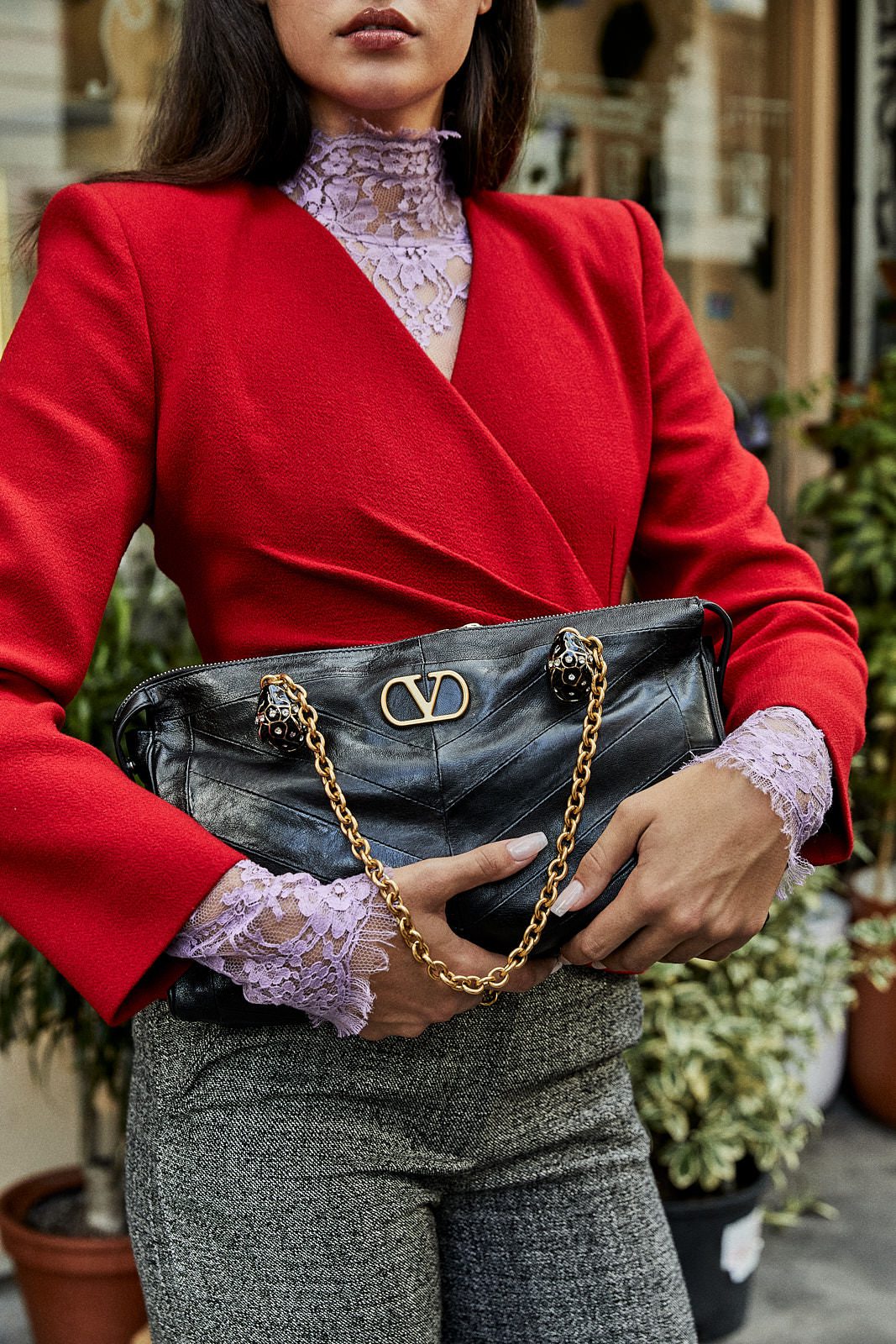
Across current lines the observed range runs from $650 to about $7,900, and the spread within a single line is often wider than the gap between lines. Roughly $650 to $1,500 is the entry band, and it holds VLogo Signature clutches, Rockstud wallets and the Rockstud mini shopping bag. The commercial core falls between about $1,650 to $3,600 and takes in most Rockstud, Rockstud Spike, Locò, VSling and VLogo shopping pieces. The top band, roughly $3,700 to $7,900, is made up of embroidery, crystal and pearl work and exotic skins. Most of the variation is driven by material: the same Rockstud mini shopping bag is $1,390 in grainy calfskin and $1,850 in pony-effect. The table below sets out the observed range for each major current line.
| Collection | Range observed | Typical entry piece |
|---|---|---|
| VLogo Signature | $650 to $3,750 | Clutch in grainy calfskin, $650 |
| Rockstud | $1,250 to $2,100 | Mini shopping bag, $1,390 |
| DeVain | $2,100 to $3,900 | Jacquard lurex shoulder, $2,100 |
| Rockstud Spike | $2,400 to $3,700 | Clutch, crossbody, $2,400 |
| Locò | $2,700 to $5,900 | Calfskin small, $2,700 |
| VSling | $3,350 to $6,550 | Small, in grainy calfskin, $3,350 |
| Panthea | $3,800 to $7,900 | Nappa and suede chevron, $3,800 |
Do Valentino bags hold their value?
Moderately, and a good deal less than the eighty percent figure that circulates online, a number no verified data supports. Resale analysis puts Valentino handbags at roughly 41 percent retention across the house. Individually, the strongest styles land between 50 and 58 percent. Among the recorded examples are the Roman Stud Flap at 58 percent, the VLogo Locò Flap Shoulder at 57, the Rockstud Drawstring Bucket and Rockstud Flip Lock Flap at 56, and the Rockstud Pouch Crossbody at 50. In practice, a medium Rockstud Spike has been seen near $1,700 against roughly $2,900 new. Recognisable motif bags hold best, which puts the house in mid-tier territory, and none of this is investment advice.
Where is it safe to buy, and does a real sale exist?
Keep to the house’s own webstore and boutiques, or to retailers verified as stocking the line: Neiman Marcus, Bergdorf Goodman, Saks Fifth Avenue, Nordstrom, Mytheresa, Net-a-Porter, Farfetch, Selfridges, Harrods, Giglio and Tessabit. A real Valentino bag sale does exist, because the house runs official seasonal sales on its own site, although as of September 2026 the US sale page said the Spring/Summer 2026 sale had ended. References to private sales in the page structure imply a newsletter-gated mechanic rather than a permanently open discount store. THE OUTNET, the off-price arm of Net-a-Porter, does carry Valentino Garavani, although how deep its discounts run is not established. An outlet boutique stands at The Mall Firenze in Leccio Reggello, Tuscany, and a store is reported at Fidenza Village. Be sceptical of any site that strings together the brand name with words like outlet or sale and offers deep permanent discounts on current-season stock.
Are the Valentino bags in off-price chains real?
Genuine, yes, but not what most shoppers assume they are buying. What Nordstrom Rack, Saks OFF 5TH and TJ Maxx carry is “Valentino by Mario Valentino”, confirmed through their own brand-filter pages. Those bags are made by Mario Valentino S.p.A., the separate Naples company, not the couture house. So the bag is authentic and the retailer is legitimate, and it is still not a Valentino Garavani bag. It will not carry GARAVANI on the interior tag, it sits at a different price point, and it will not behave like a Garavani piece on resale. Assume no US off-price chain is discounting genuine Garavani stock, and read the label before you read the price tag.
Which one should I carry every day, and how do I maintain it?
For daily carrying, grainy calfskin in a recognisable silhouette is the most defensible choice: the Rockstud mini shopping bag at $1,390 if you want a Valentino tote bag, the small Rockstud crossbody at $1,650 if you want a Valentino crossbody bag, or the Rockstud small shoulder at $2,100 for a Valentino shoulder bag. Grainy calfskin keeps its shape, resists scuffing and hides fingerprints, and it is usually the cheapest material in its line. What follows is general luxury-leather practice, not official instruction: wipe nappa and calfskin with a soft dry cloth, use a nappa cream, blot stains, and air dry rather than heat. Suede and kidskin call for a dry brush and a protector spray, kept away from water and oils. With laminated, metallic and mesh pieces the finish gives out before the leather does, and python and ostrich require professional care and no direct sun. Never polish plated antique-brass or light-gold hardware, and keep the bag in its dust bag, lightly stuffed, cool, dry and uncompressed.